
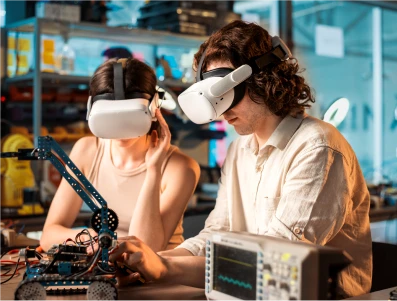
Explore how innovations like AI, virtual reality, and streaming platforms are revolutionizing the entertainment landscape. Learn how these technologies are creating new opportunities for aspiring professionals.
Not long ago, a career in entertainment meant following one of a few well-worn paths: work your way up on a film set, take an assistant job at a record label, or start at the bottom of an agency. Those paths still exist, but they now run alongside dozens of new ones. Streaming platforms, artificial intelligence, virtual and augmented reality, and real-time game engines have changed how stories get made, how music gets discovered, and how audiences find what they love.
For students and early-career professionals, that shift is good news. Every new technology creates new problems to solve, and every new problem creates work for someone. Here is a look at the forces reshaping entertainment and what they mean for you as you go after your first internship.
Streaming Changed the Rules
Streaming did more than move movies and shows from cable boxes to apps. It changed the business model behind them. Platforms make decisions based on how viewers actually behave: what they start, what they finish, and what they come back to. Music streaming works in a similar way, with playlists and recommendation algorithms playing a big role in which songs break through.
That shift created demand for people who understand both content and data. Studios and labels need analysts who can read viewing or listening trends, marketers who know how to launch a release on a specific platform, and content teams who can package titles so they stand out in a crowded catalog. If this interests you, look for internships in content strategy, audience insights, or digital marketing. You do not need to be a data scientist, but comfort with spreadsheets and basic analytics will set you apart.
AI Is Becoming a Creative Tool
Artificial intelligence is showing up across the entertainment pipeline. It powers recommendation engines, helps clean up dialogue and audio, speeds up tedious tasks like rotoscoping and subtitling, and assists with early brainstorming and previsualization. It is also raising serious questions about authorship, likeness rights, and fair pay, which is why it became a central issue in recent Hollywood labor negotiations.
For newcomers, the takeaway is not that AI will replace creative work. It is that people who understand how these tools work, where they help, and where they fall short make valuable collaborators. Editors, sound designers, marketers, and producers who can use AI tools responsibly, and explain their limits to a team, are already in a stronger position.
Learn the tools, but also learn the debates around them. Knowing the ethics and the rules is part of being a professional in this industry.
New Ways to Build Worlds
Virtual Production and Real-Time Engines
One of the most visible changes on set is virtual production. Instead of shooting actors in front of a green screen and adding backgrounds months later, many productions now use large LED walls that display digital environments rendered in real time by game engines. Actors can see the world they are performing in, cinematographers get realistic lighting and reflections in camera, and directors can make creative decisions on the day instead of waiting for post-production.
This approach blends filmmaking with skills that used to belong mostly to the video game world. Productions need technical artists, real-time environment builders, and engineers who keep the system running. If you have a background in 3D modeling, game design, or computer graphics, film and television may be more open to you than you think.
Immersive Experiences: VR, AR, and Beyond
Virtual and augmented reality are still finding their audiences, but they are already used for concerts, theme park attractions, marketing campaigns, and interactive storytelling. Musicians have performed virtually inside games, and studios use AR filters to promote films and albums.
These projects often rely on small teams where everyone wears several hats: producers who understand technical constraints, designers who think in three dimensions, and developers who can prototype quickly. Interning on an immersive project can give you a wide range of experience in a short time.
The Creator Economy Blurs the Lines
Social platforms have turned individual creators into small media companies that run production teams, sign brand deals, and release music without a traditional gatekeeper. Studios and labels, in turn, partner with creators to reach new audiences.
That has opened a new category of entry-level work: editing short-form video, managing community engagement, coordinating brand partnerships, and tracking performance across platforms. These roles reward people who are fast, creative, and fluent in internet culture.
How to Prepare for What Comes Next
Nobody can predict exactly which technologies will dominate five years from now, but you can build habits that keep you adaptable. Here are some practical steps:
- Pick one tool and go deep. Learn a game engine, a video editor, a digital audio workstation, or an analytics platform well enough to show real work.
- Build a small portfolio. A short film, a remix, a social campaign you ran for a student group, or a simple interactive project shows initiative far better than a list of skills.
- Follow the business, not just the tech. Read industry trade publications and pay attention to how companies make money, not only what new gadgets they announce.
- Talk to people doing the work. Informational interviews with editors, producers, engineers, and marketers will teach you which skills matter on the ground.
- Say yes to hybrid roles. Some of the most interesting internships sit between departments, like a marketing role that needs video skills or a production role that needs some coding.
Where You Fit In
The entertainment industry has always needed storytellers, organizers, and problem-solvers. Technology has changed the toolkit and the number of doors you can walk through. A student who edits videos for fun or builds small games already has skills companies want.
At Intern Nation, we believe in a simple progression: Outside to Intern, Intern to Employee, Employee to Owner. Your first internship is the step that gets you inside, and the industry's evolution means there are more ways in than ever. When you are ready, browse internships across production, music, marketing, social media, and creative tech, and start building a profile that gets you noticed.